When design and manufacturing are split, every revision holds the project up
A robot cell contains dozens of custom parts: fixture plates, pins and bushings, gripper bodies, robot and positioner bases, guarding. With the design in one place and manufacturing spread across several suppliers, every revision means a new quote, a new place in the queue and a new delivery. If a locating pin has to move 2 mm during commissioning, the cell waits for that part.
Quality has a similar problem. Even when a part matches the drawing, information gets lost between the person who drew it and the person who machined it. Which face is the datum, which dimension is functional and where weld distortion is expected are not always on the drawing.
What we make
Precision machining. We machine fixture and machine components: clamping plates, pins and bushings, datum blocks, gripper bodies, shafts and flanges. What matters here is not only holding the dimension but where it is measured from. When locating holes and datum faces are machined in the same setup, the relationship between them stays intact.
Welded fabrication. Frames, bases, robot and positioner pedestals, guarding and support structures. A welded frame distorts from the heat of welding, so we design precision faces to be machined after welding, with stock left for it.
Special machines and equipment. When a job has no off-the-shelf answer, we design and build the machine from scratch. When standard equipment already does most of the job, we adapt it to your part and your line instead of starting over: a new clamping arrangement, a different infeed, added guarding or a controls change.
One honest limit: precise machining won't rescue a badly designed fixture. If the datum and clamping logic is wrong, the problem stays however accurately the part is made. That's why we review the design together before anything is cut.
Workshop, materials and measurement
We do machining and welded fabrication in our own workshop.
- Materials and tolerances: we agree tolerances and materials with you in the quote, based on the drawing.
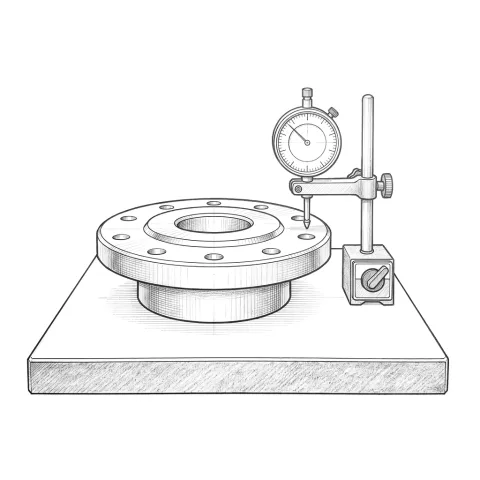
- Measurement: we check critical dimensions and record the results.
- Surface treatment: we state the surface treatment each part needs in the quote.
What traceable quality means here
For every part we keep a record of the drawing revision it was made to, the material it was made from and how its critical dimensions were checked. When a fixture wears out years later and needs a spare, being able to make the same part again from the same drawing depends on that record.
Build to print for integrators and machine builders
Our manufacturing serves our own projects first. Integrators and machine builders who outsource fixtures and parts can also work with us on parts, fixtures or welded structures built to their drawings.
How a job runs
- Drawing or requirement: on our own projects the design is ours. For work that arrives as drawings, we first agree on the drawing and the critical dimensions.
- Manufacturing plan: we decide which faces are datums and what gets machined after welding.
- Manufacturing: machining, welded fabrication and surface treatment.
- Inspection: critical dimensions are checked and recorded.
- Assembly and site: parts are assembled into the cell, and our installation and commissioning crew handles fitting and adjustment on site.
Questions buyers ask
Do you take one-off and small-batch work? Fixtures and special machines are one-off and small-batch by nature, and we plan our manufacturing around that.
Can you remake a worn fixture part? If we have the drawing, we make the same part again. If there is no drawing, we measure the part and draw it. If the wear keeps coming back, we suggest a change of material or hardening. Spare parts for fixtures and grippers fall under this too.