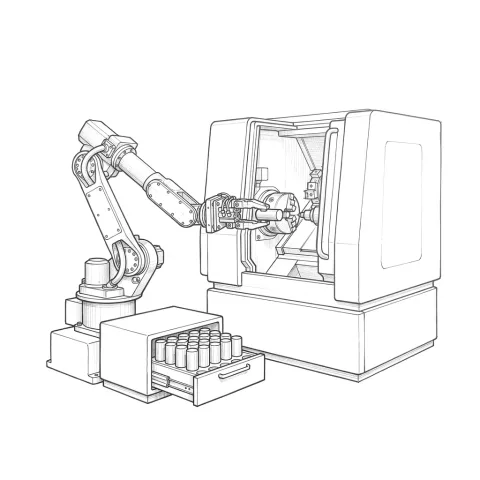
The machine isn't cutting. It's waiting for the operator.
What a CNC machine produces depends on how long the spindle is actually cutting. When the operator goes on break, the shift changes or they step over to the next machine, the door stays open and the part waits. A machine that runs three shifts on paper sits idle for a noticeable share of that time.
The loss also burns skilled people. An experienced machinist spends the shift loading and unloading parts instead of on setup, measurement and tool changes. Finding someone for the night shift is another problem altogether.
How robotic machine tending works
The robot picks a raw part from a buffer, reaches in when the machine door opens, removes the finished part and clamps the new one. The door closes and the machine starts its cycle. Meanwhile the robot puts the finished part on a measuring station, the outfeed side of the buffer or a conveyor.
Success is decided by five things, and the robot is not one of them:
- Part presentation: the robot has to find each raw part in a known position. Drawer buffers, trays with locating pins, conveyors, or machine vision when parts arrive in random positions. Picking loose parts with a camera is possible, but it raises both cost and risk.
- Gripper: most applications use a double gripper. The robot enters the machine once, takes the finished part with one gripper and loads the raw part with the other. That keeps the door-open time short. More on the gripper design page.
- Machine interface: the robot and the machine controller exchange signals such as "door open", "chuck open", "vise closed" and "cycle start". An automatic door, hydraulic or pneumatic workholding, and whether these signals are available on the machine are the first things we check on site. On older machines they can be retrofitted.
- Chips and coolant: the gripper and sensors have to survive swarf and coolant. A chip left in the chuck makes the part seat wrongly, so cells often include an air blow-off and a check that the part is seated correctly.
- Buffer size: the buffer has to hold at least as many parts as the unmanned (lights-out) period needs. With a 4-minute cycle time, 8 hours of unmanned running means a buffer of roughly 120 raw parts.
One limit, stated up front: the robot feeds the machine, but it doesn't deal with chips, tool wear or dimensional drift on its own. Long unmanned runs also need measures on the machine side, such as tool life monitoring, in-process gauging or sister tools. We look at these together on the first visit.
Which machines?
- CNC lathes and machining centers: parts held in a chuck or vise, one robot serving one or several machines.
- Presses: loading and unloading for blanking, bending and forming presses. Press safety and the robot's position inside the press are handled together in the safety circuit.
- Injection molding machines: taking parts from the mold, removing sprues and passing parts on to the next operation.
How a project runs
- Site visit: the part, the machine, the workholding, current cycle time and the target unmanned hours.
- Concept and simulation: we verify the robot's reach into the machine and the cycle time in simulation.
- Design and manufacturing: gripper, buffer, guarding and machine interface.
- Installation and commissioning: connecting the machine signals, the robot program and trial runs with real parts.
- Training: your operators learn to set up a new part, fill the buffer and restart the cell after a fault.
Questions buyers ask
Can a robot be added to our existing machine? Usually, yes. What matters is an automatic door, automatic workholding and a controller that accepts external signals. If these are missing they can be added, and the cost depends on the machine's age and controller.
Can one robot tend more than one machine? Yes, if the machines' cycle times are long enough compared with the robot's work at each machine. We calculate the waiting time between machines in simulation.
We change parts often. Does a robot still make sense? If the parts belong to similar families, one gripper and adjustable trays are often enough. Very different parts can use a quick-change tool changer. How many minutes a changeover takes is part of the design.