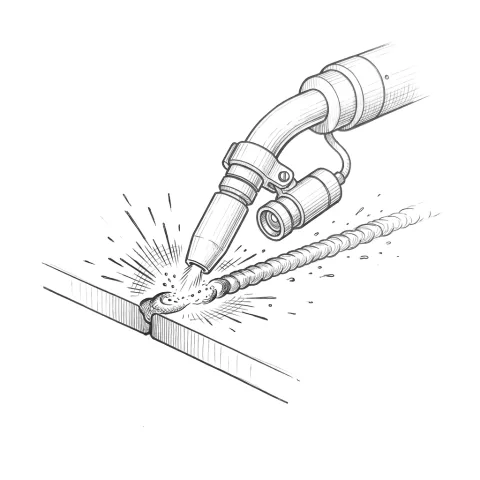
How weld quality is proven today
In most plants, weld quality is proven by cutting a part at set intervals during the shift, etching the cross-section and inspecting it under magnification. The macro section really does show penetration and weld geometry. But it is slow, it destroys the part and it only sees the sample.
The real problem is the parts made between two sections. The morning section passes, in the afternoon a nozzle fills with spatter, and nobody notices until the next section. The parts made in between are either quarantined and checked one by one, or they ship. When the complaint arrives, there is no record to put in the 8D report.
How it works
The arc is many times brighter than the weld pool and the part around it. An ordinary camera is either blinded by the arc or leaves the pool in the dark. A high-dynamic-range (HDR) camera built for welding can show the arc, the pool edges, the wire tip and the area around the seam in the same frame.
Systems of this kind compare every weld with a reference built from good welds. If the size, shape, position or stability of the pool departs from that reference, the seam is flagged. We develop our system in-house.
What it sees, and what it doesn't
The camera sees the surface of the weld and the welding process. It does not see inside the weld. We make that distinction clear from the start.
| The visible process: what it can flag | Inside the weld: what the camera cannot see |
|---|---|
| Irregular or unstable weld pool | Internal porosity |
| Missing, short or interrupted welds | Penetration depth |
| Burn-through | Lack of fusion at the root or sidewall |
| Excessive spatter | Internal cracks |
| Weld off the seam, wrong position | |
| Arc instability, wire feed problems |
A change in pool width can be an indirect sign of a penetration problem, but it is not a measurement. That is why weld pool monitoring does not do away with macro sections. It reduces how many you cut, and it points them at the parts the system flagged instead of a random sample. The section frequency is usually set in the control plan and the customer-specific requirements, so changing it may need your customer's agreement. The monitoring records give you hard data for that conversation.
We also state which defects the system has been validated on: for your part, material and welding process, we put this in writing in the quote.
What happens when a weld is flagged
- The system sends a signal to the PLC during or right after the weld.
- The PLC acts on the rule you set: it stops the cell and waits for the operator to acknowledge, marks the part, or diverts it to a reject bin.
- The operator sends the flagged part to repair or to a macro section check.
- The result for every part is stored: part number, time, seam and result.
That record is traceability. When a complaint comes in, you can show what happened on which seam of which part in that batch.
A balance to agree before go-live
If the thresholds are too tight, the system flags good parts and operators stop trusting the alarm. Too loose, and it misses defects. We set that balance on your part, using good welds and deliberately produced bad ones. It is the most important part of commissioning.
How a project runs
- Quality data review: which defects cause complaints or rework, and what do your macro sections show?
- Trial welds: we test the system with your part and your weld parameters.
- Installation and integration: camera mounting, robot and PLC connection, data recording.
- Thresholds and validation: we compare results with macro sections and sign them off together.
- Training: operators learn what to do with a flagged part, and the maintenance team learns to clean and replace the protective glass.
Questions buyers ask
Can it be added to my existing welding robot? Usually, yes. Compatibility depends on the robot controller and the space around the torch.
Is it the same as seam tracking? No. Seam tracking makes sure the robot welds in the right place. Weld pool monitoring checks whether the weld itself is good. Both can run in the same robotic welding cell. For visual inspection beyond welding, see machine vision.