Robotic Welding: Repeatable Quality Comes From Three Things
Repeatable quality in robotic welding comes from three things working together: a fixture that holds the part the same way every time, a robot that finds the real seam, and a check that every weld is good. We build all three, including our own camera systems, for production managers and welding engineers at plants that weld, for example automotive suppliers and metal fabricators.
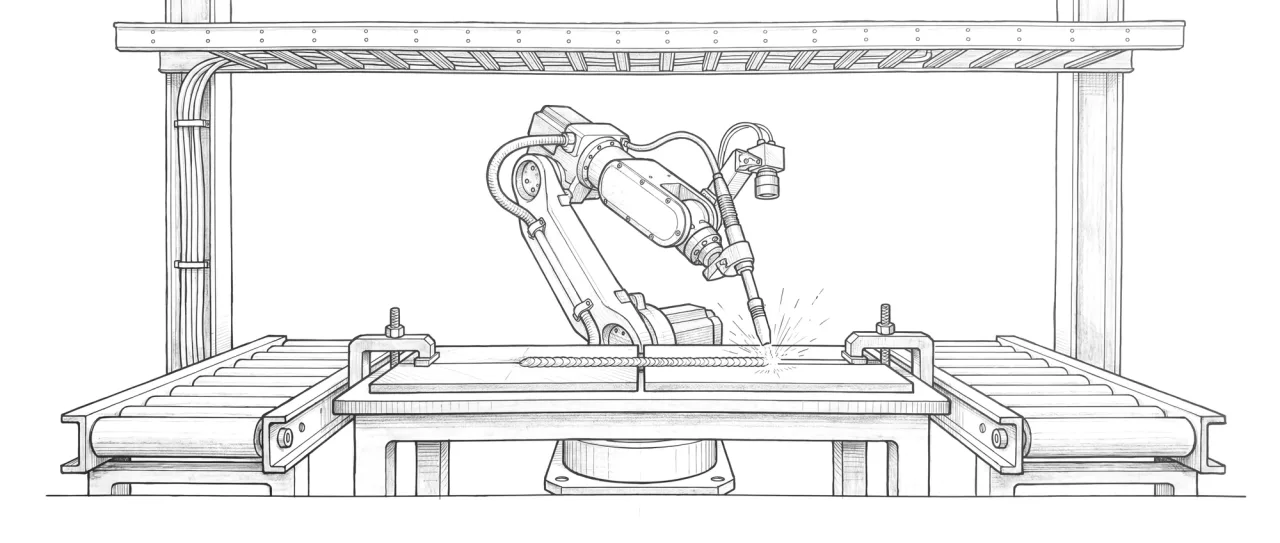
Robotic welding cells
Welding robot cellA turnkey MIG/MAG welding cell combines the robot, positioner, torch and wire feed, torch cleaning station, fixtures, safety equipment and PLC into one station. Whether you need a single station, or two stations where the operator loads one side while the robot welds the other, follows from your target cycle time. Details on the robotic welding cell page.
Weld seam tracking
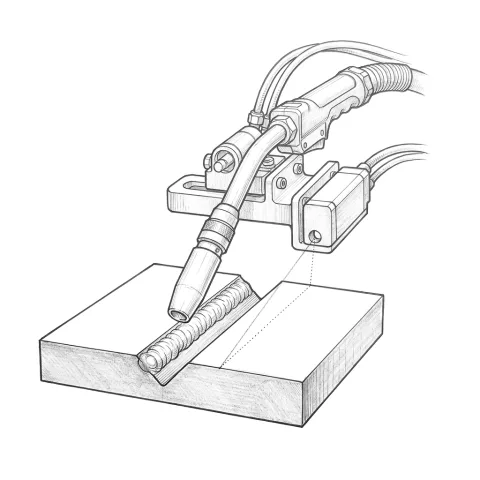 Seam tracking
The robot follows its programmed path the same way every time, but pressed sheet metal, worn locating pins and heat distortion move the seam. Seam tracking finds where the seam really is with a camera and corrects the robot path while it welds. It can be part of a new cell and, in most cases, retrofitted to a welding robot that is already in production.
Weld pool monitoring
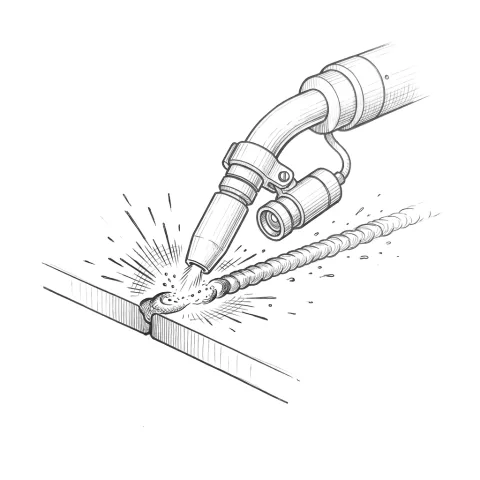 Weld pool monitoring
In most plants, weld quality is still proven by cutting sample parts and inspecting a macro section: slow, destructive, and it only sees a sample. Weld pool monitoring watches the molten pool with a camera during welding, flags irregularities as they happen and keeps a record for every part. It does not end cut-and-etch testing; it reduces it and points it at the right parts.
Underneath it all: fixtures and sensors
The best robot still welds in the wrong place if the part is held wrong. We design and manufacture welding fixtures ourselves, so the team that draws a fixture is responsible for building it. The sensors that confirm the part is in place have to survive welding current and spatter. We are an official partner of the French sensor maker Senstronic; sensor selection is covered on the Senstronic sensors page.
Why these belong together
A weld defect rarely has a single cause. A locating pin wears, the seam shifts, the robot welds the shifted seam, and the defect only shows up in a macro section or at the customer. The fixture holds the part the same way, seam tracking catches the deviation that is left, and pool monitoring checks the result on every part. When one team designs all three, it is much easier to tell whether a problem comes from the part, the fixture or the program.
Related pages
- FixturesIn robotic welding, the fixture is the quality. We design and build welding, assembly and inspection fixtures; the team that draws them also builds them.Go to page
- Senstronic sensorsWe select inductive, magnetic, capacitive and photoelectric sensors for fixtures, weld cells and conveyors, with Senstronic sensors for harsh environments.Go to page
- Your Welding Robot Misses the Seam: Is It the Part, the Fixture or the Program?When a welding robot misses the seam, the cause may be the part, fixture, TCP or program. How to diagnose it, what to fix first and which tracking fits.Go to page
Let's look at your welding line
On a site visit we look at the part you want to weld, the current station and the quality issues you are dealing with. On that first visit we'll work out which part really needs which solution.
Or call us now: +90 533 268 32 34