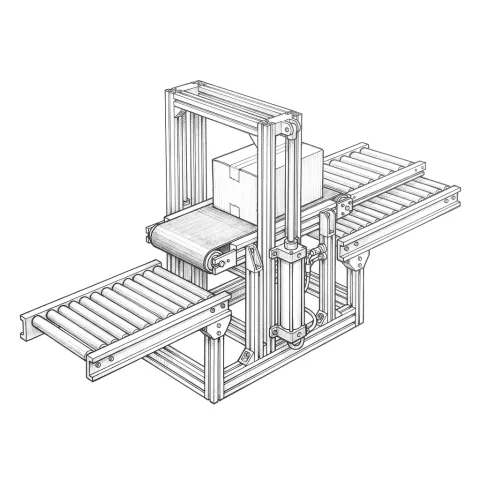
The trouble is rarely the conveyor. It's where conveyors meet.
A conveyor looks like the simplest machine on the line, so it is usually the last thing anyone thinks about. Then the problems start. Product jams where two conveyors meet, boxes push against each other in the accumulation section, and the robot finds the part in a slightly different place each cycle. Maintenance has to remove half the guarding to change one bearing.
Controls are a separate problem. A conveyor that doesn't talk to the line PLC keeps sending product when the station ahead has stopped. The robot either sits idle or an operator ends up running the line by hand.
Which conveyor for which job?
| Type | Good for | Watch out for |
|---|---|---|
| Belt | Light to medium loads, irregular bases, small parts, inclines | Poor for accumulation: the belt keeps running underneath and products press against each other |
| Gravity roller | Rigid, flat-bottomed boxes, totes and pallets; short unpowered transfers | Slope and product weight set the speed, with little control; slope must be calculated for the load |
| Driven roller | Boxes, totes and pallets; zoned control and zero-pressure accumulation | Product base should rest on at least three rollers; roller pitch follows the product |
| Chain | Pallets, heavy workpieces, oily or hot parts | Chain tension and lubrication go into the maintenance plan; sprockets need good guarding |
| Modular plastic belt | Curves, washdown lines in food and packaging | Belt material chosen for product and ambient temperature |
The line elements around the conveyor matter as much as the conveyor itself:
- Buffers (accumulation sections) absorb speed differences and short stops between stations. If the upstream station stops for a few minutes, the robot keeps getting parts.
- Transfers move product between parallel lines or onto a conveyor at a right angle.
- Turntables change the flow direction or the product's orientation, including turning it to the side the robot picks from.
- Lifts and elevators move product to a different level, for example over a walkway or up to a mezzanine line.
What we look at in the design
- The product: weight, size, base surface and fragility. Everything from roller pitch to belt type starts here.
- Rate and spacing: products per minute and the gap between them have to match the robot's cycle time.
- Accumulation: where products must wait without touching, we use zero-pressure accumulation. The line is split into zones, each watched by a sensor, and a zone stops when the one ahead is occupied. Fragile or labelled products don't crush each other while they queue.
- Transfer points: this is where most jams happen. Height differences, the gap between two conveyors, speed mismatch and guide positions are designed together.
- Guarding: rollers, drums, chain sprockets and transfer gaps are nip and shear points for hands and fingers. EN 619 is the European safety standard for conveyors handling unit loads.
- Maintenance access: drives, bearings, belt tensioners and chain lubrication points should be reachable through covers that open easily.
- Controls integration: sensors, frequency inverters, the PLC and signal exchange with the robot cell, including the emergency stop circuit.
One limit, stated up front: a conveyor won't bring order to product that arrives in random orientation. If it does, you need mechanical guides or machine vision, and we discuss that at the layout stage.
Feeding robot cells and the end of the line
A robot expects the part at a known point, in a known orientation. So at the pick point we build a station that stops the product, centres it and confirms with a sensor that it is in place. At the end of the line, the infeed into a robotic palletizing cell and the pallet in and out conveyors are designed together with the cell. When the conveyor has to tie into overall line control, we handle it together with machine and line automation.
What we do
- Flow analysis and layout
- Mechanical and electrical design of conveyors and line elements
- Manufacturing
- Site installation and integration with the existing line (installation and commissioning)
- Commissioning and training for your maintenance team
How a project runs
- Site visit: we look at the product, the line, the target rate and the available floor space.
- Flow and layout: we choose conveyor types, buffer capacity and transfer points.
- Design: mechanical, electrical and guarding design are done together.
- Build and pre-test.
- Installation and tie-in: we connect to the existing line during a planned stop, with as little impact on production as possible.
- Commissioning and training.
Questions buyers ask
Can a new conveyor be connected to our existing line? Usually, yes. We check heights, speeds, the transfer point and signal exchange with the existing PLC on site. If the old line's control system is undocumented, we document it first.
Isn't a gravity roller conveyor enough? For short, simple transfers, yes, and it needs no power. But you have little control over its speed, and products accumulate by bumping into each other. If the robot needs to find the part stopped at a defined point, a driven, zoned conveyor is the better choice.