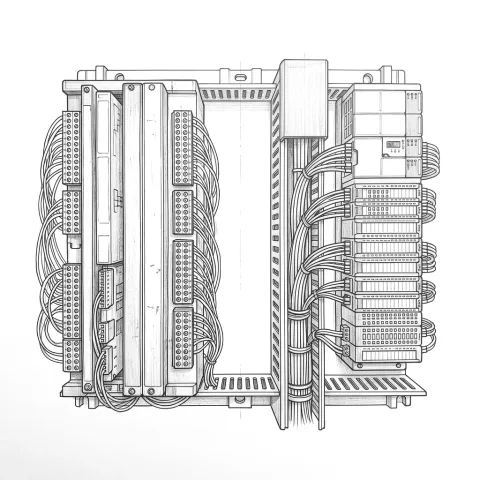
A PLC without spare parts turns a fault into a long stoppage
An old PLC can run for years without a fault. The risk starts on the day it fails. When the CPU or an I/O module goes, there is no replacement on the shelf. A part from the second-hand market comes with an unknown history and a price that rises every year.
Most plants have a second problem as well. The person who wrote the program left years ago. The last backup sits on an old programming device, or doesn't exist. The electrical drawings don't show the changes made on site. Searching for that information during a breakdown turns hours of downtime into days.
Where do S5 and S7-300 stand?
SIMATIC S5 has been out of production for a long time and Siemens no longer supports it. Parts come only from the second-hand market.
SIMATIC S7-300 and ET 200M are younger, but their clock is running too. On 1 October 2025 Siemens moved both families to lifecycle status PM410, type discontinuation. Since then they can no longer be ordered for new installations or extensions, modules are supplied only in spare-part quantities, and prices are expected to rise. The successor Siemens recommends is S7-1500 with ET 200MP or ET 200SP I/O.
This is not a reason to panic. Siemens states that the S7-300/ET 200M families will be available until 2033. After PM410, though, that supply is for spare parts, not for new investment. A planned migration costs less and takes less time than one rushed through after a failure.
What changes in a migration?
A migration is more than swapping the CPU. We handle four layers together:
- Program: the existing program is read from the PLC and rebuilt for S7-1500 in TIA Portal. S7-300 programs can largely be carried over, but they are reviewed block by block because some instructions and addressing work differently. S5 programs come from a different architecture. Conversion tools give a starting point, but a readable, maintainable S7-1500 program takes real engineering.
- I/O and panel: every signal, field device and network connection is listed. New modules go into the existing panel, or a new panel is designed.
- HMI: if the old operator panel cannot talk to the new PLC, or is itself end-of-life, its screens move to a new panel.
- Drives: older drive families such as MASTERDRIVES have the same spare-part problem. We replace end-of-life drives with current series.
One limit, stated up front: with incomplete documentation, we can't know everything from the desk. Years of on-site bridges and workarounds live in both the program and the panel. To find them before the shutdown, we observe the system while it runs and go through it with your maintenance team.
What we do
As a Siemens partner, we cover:
- Backing up, reading and documenting the existing program
- Recording the I/O list, field devices and network layout
- Converting or rewriting SIMATIC S5 programs for S7-1500 in TIA Portal
- Moving S7-300 and ET 200M systems to S7-1500 with ET 200MP or ET 200SP
- Designing a new panel or adapting the existing one
- Rebuilding HMI screens
- Replacing end-of-life drives with current series
- Pre-shutdown testing, commissioning and up-to-date documentation
- 24/7 support after the switch-over through our PLC and SCADA support
How a project runs
- Site visit and backup: we come on site, back up the running program and look at the panels and field devices in place.
- I/O list and documentation: we list every input, output, drive and network connection and write down what the existing program actually does.
- Program: we build the S7-1500 program in TIA Portal.
- Panel preparation: the new panel, or the modules going into the existing one, are built and tested before the shutdown.
- Testing before the shutdown: we run the program in simulation with PLCSIM and signal-test the panel in advance. We want to find errors before shutdown day, not during it.
- Switch-over in a planned shutdown: in Turkey the usual windows are the Bayram (Eid) holidays, the year-end break and the summer maintenance shutdown. Removal, installation, signal checks and first start-up are planned hour by hour to fit that window.
- Commissioning and handover: the machine runs at production rate. You receive the updated electrical drawings, program backup and I/O list.
Questions buyers ask
Can it be done in one shutdown? With good preparation, often yes. What decides it is how much work is finished before the shutdown: a tested program, a ready panel and an I/O list checked on site. On large lines, splitting the migration machine by machine over several shutdowns can be the safer choice.
Can we keep the existing panel and field wiring? Often in part. The enclosure, field devices and cables usually stay. For some S5 and S7-300 modules there are adapters that connect the old front connector to the new system, so the field wiring is not disturbed. Not every module type has one, and supply voltage and signal compatibility have to be checked case by case. We work out what is possible module by module during the site visit.
What about the HMI and the drives? Keeping the operator panel depends on whether it can communicate with the new PLC and on its own spare-part status. If the panel is the same generation as the PLC, replacing both together usually makes more sense. For drive families that are out of support, a PLC migration is a good moment to move the drives to a current series too.
What does it cost? We need to see the system before giving a figure. The main cost drivers are:
- Number of I/O points and machines the PLC controls
- State of the existing program and documentation (S5 code and missing drawings add work)
- New panel or adaptation of the existing one
- Number of HMIs and drives
- Length of the shutdown window and the need for shift work on site
Put the other side in the comparison too: what one day of unplanned downtime on that line costs, and the time spent hunting for parts.