The robot repeats. The part doesn't.
A welding robot follows its programmed path with very high repeatability. The trouble is that the part is not where the program assumes it is. A millimeter or two of variation in pressed sheet metal, a worn locating pin or a part that distorts from welding heat moves the seam. The robot welds the old path anyway.
On the shop floor it always looks the same: one edge of the seam is missed, there is undercut or burn-through, and the operator sets the part aside for repair. Rework goes up, cut-and-etch checks fail, and the cell never reaches the capacity it had on paper.
How seam tracking works
There are three established methods:
- Touch sensing: the welding wire touches the part to find reference points. Little extra hardware, but the search time is added to every cycle.
- Arc sensing (through-arc tracking): while the robot weaves, it reads changes in the arc current to find the center of the joint. Suited to certain joint types and plate thicknesses.
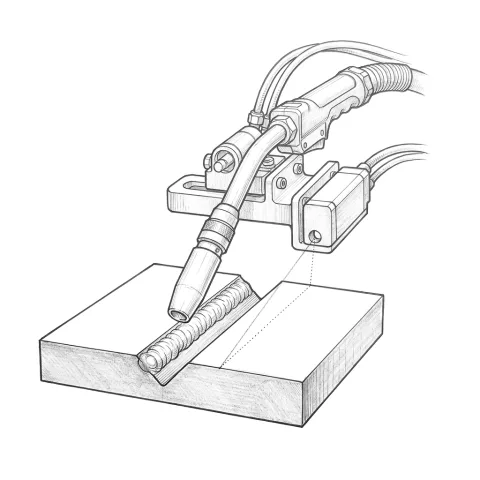
- Optical tracking: a sensor ahead of the torch sees the seam and corrects the path during welding. No added search time. The most flexible option for thin sheet and complex geometry.
The system Piot develops is camera-based. The camera watches the seam ahead of the torch, calculates the deviation and sends the correction to the robot controller while the weld is running.
One limit, stated up front: seam tracking does not make up for a bad fixture. If the part seats differently every time it is clamped, the fixture needs fixing first. We look at this together during the first visit.
When do you need it?
- The seam position varies from part to part by more than the wire tip can tolerate
- The same cell welds parts from different dies or different suppliers
- Heat distortion moves the seam during long welds
- Touch sensing pushes the cycle time over target
- Bringing parts to "robot-ready" tolerances would cost more than tracking the variation
Can it be added to an existing cell?
Usually, yes. Seam tracking can be part of a new cell or retrofitted to a welding robot that is already in production. Compatibility depends on the robot brand and controller generation. For an existing cell we also check sensor mounting, cable routing and clearance around the torch.
How a project runs
- Part and seam analysis: using sample parts and current weld results, we find where the deviation comes from: the part, the fixture or heat distortion.
- Trial welds: we test the system on your part.
- Installation and integration: sensor and torch mounting, controller connection, robot program changes.
- Validation: we sign off the result together using cut-and-etch checks and real production parts.
- Training and support: your operators and maintenance team learn calibration, protective glass cleaning and what to do when something goes wrong.
Questions buyers ask
Does seam tracking slow down the cycle? Optical tracking works during the weld, so it needs no separate search move; it adds little or no time to the cycle. Compared with a cell that uses touch sensing, cycle time often goes down.
Doesn't the arc light and spatter blind the camera? Optical systems built for welding use filters against arc light and a replaceable protective glass. Cleaning and replacing that glass is part of the maintenance plan.
How is this different from weld pool monitoring? Seam tracking makes sure the robot welds in the right place. Weld pool monitoring checks whether the weld itself is good, while it is being made. The two can run in the same cell.