Why plants move to robotic welding
Two reasons come up every time. The first is people: good welders are hard to hire and harder to keep. The second is consistency: the same part is welded by one person on the morning shift and by another at night, and the macro sections show it.
A robot repeats the programmed path, speed and torch angle on every part. Your welders move to the difficult, low-volume work that does not suit a robot. But the robot does not guarantee quality on its own. If the part does not arrive in the same place every time, the robot will consistently weld in the wrong place.
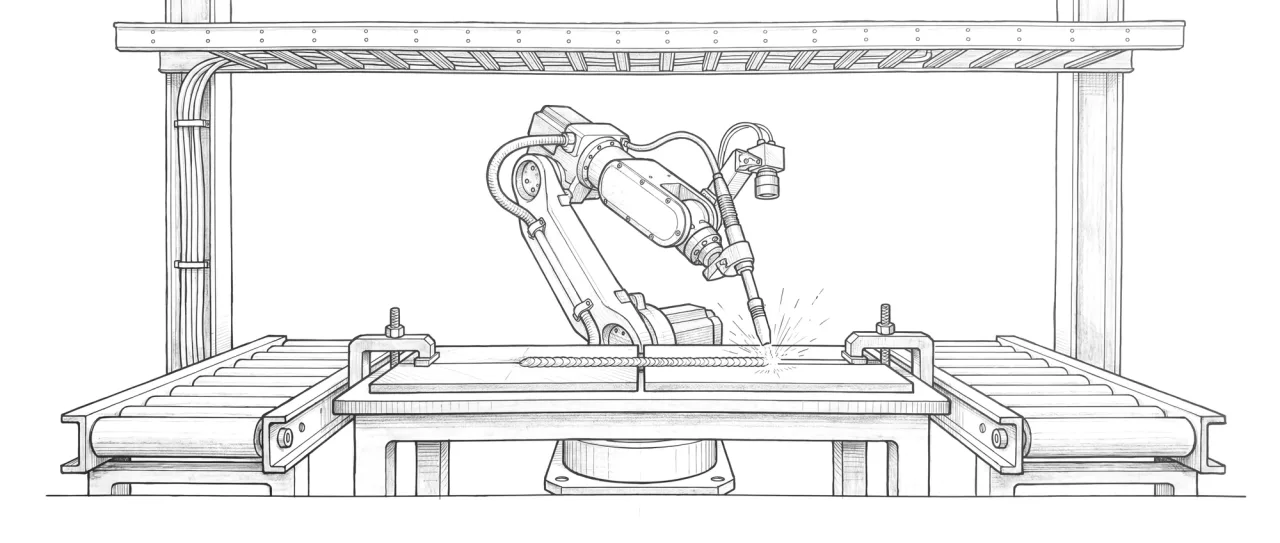
What's in the cell
- Welding robot and controller: reach and payload are chosen for the part and the torch package.
- Positioner: turns the part so the robot reaches every seam at the right angle, and brings the seam into the flat position where possible. In the flat position the weld pool is not fighting gravity, so the robot can weld faster with a more even bead.
- Welding power source, torch and wire feeder
- Torch cleaning station: at set intervals it reams spatter out of the nozzle, cuts the wire to length and sprays anti-spatter fluid.
- Fixtures: designed and manufactured by us. See welding fixtures.
- Safety: fencing, arc screens, interlocked doors or light curtains, emergency stops and a safety circuit with a defined Performance Level.
- PLC and operator panel: part type selection, station sequence, fault messages and communication with your line.
- Programming, commissioning and training: robot program, weld parameters, training for operators and maintenance staff.
Where needed, seam tracking and weld pool monitoring are added to the same cell.
Four things decide success, and the robot is not one of them
- The fixture. A fixture that does not hold the part in the same place every time will make the best robot weld in the wrong place.
- Part fit-up. A manual welder sees the gap between two parts and adjusts; a robot does not. If the joint gap varies from part to part, the problem is not the welding but the parts coming from the press or the cutting line. We look at this on sample parts during the site visit.
- Programming. Weld sequence matters as much as torch angle, travel speed and parameters. The order of the seams decides where heat distortion will pull the part.
- Torch and consumable maintenance. A worn contact tip lets the wire wander, a nozzle full of spatter disturbs the gas shield, and a small collision shifts the tool center point (TCP). All of these belong in the maintenance plan.
Single station or two stations?
If the robot is not welding, the cell is not producing. So when we choose a layout, we look at how long the robot spends waiting.
| Layout | How it works | When it fits |
|---|---|---|
| Single station | The operator loads, the robot welds, the operator unloads. One waits while the other works. | Low volumes, large parts, jobs where welding time is much longer than loading time |
| Two stations | The robot welds at one station while the operator loads the other, then the robot moves across. | Series production where loading time is close to welding time |
| Turntable | A two-sided table. The operator loads the outer side while the robot welds the inner side, then the table indexes. | Small and medium parts, short cycle times |
With two stations or a turntable, loading time drops out of the cycle time: the robot no longer waits for the operator to clamp the part. An arc screen separates the two sides, and the safety circuit prevents the robot from welding at the station where the operator is working. We show which layout meets your target cycle time in simulation before installation.
Questions buyers ask
What drives the price of a robotic welding cell? The number of robots and their reach, the type of positioner and its number of axes, the number of stations, how many part variants need fixtures, the safety concept and integration with your line. Adding seam tracking or weld pool monitoring also changes the price. That is why we quote after we have seen your part and your target cycle time.
How long does a project take? Robot delivery time, the number of fixtures and your own production calendar matter most. We give the project duration in writing in the quote once the scope is clear.
Is the cell CE marked? The robot arrives as partly completed machinery with a Declaration of Incorporation. The CE mark goes on the cell built around it, and whoever builds the cell is usually its manufacturer in the legal sense. That requires a risk assessment (ISO 12100), ISO 10218-2 for the robot system, ISO 13849-1 for the safety circuit, a technical file and a Declaration of Conformity. For cells going into the EU, note that Regulation (EU) 2023/1230 replaces the Machinery Directive from 20 January 2027.