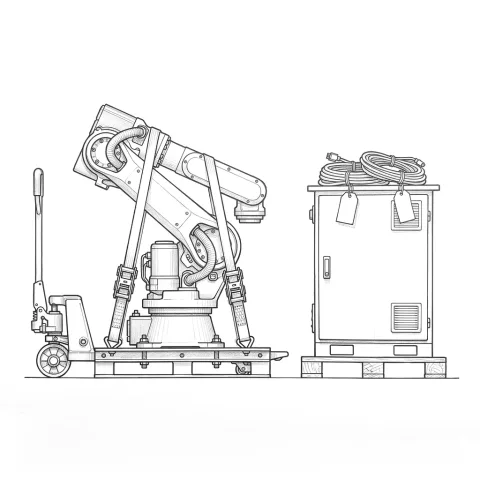
Why a relocated cell doesn't run on day one
Taking a cell apart is the easy part. The trouble starts at the new location. Cables cut without labels, a program backup that is missing the latest changes, a robot that lost its position because the backup battery ran down. The floor is at a different level, the robot sits a few millimetres differently relative to the fixture, and the taught points no longer land on the part.
Then there is documentation. The company that built the cell is long gone and the electrical drawings are out of date. A job that should take days turns into weeks of re-commissioning.
Relocation, step by step
- Survey and documentation: we see the cell running and photograph it. We check the existing drawings and electrical schematics and produce what is missing. We back up the robot programs, robot configuration (including safety configuration) and the PLC and HMI projects. Before the move, we run a reference part and record its dimensions.
- Dismantling and labelling: every cable and hose is labelled at both ends. The robot is put in the transport position specified by its manufacturer. Fasteners and small parts are packed cell by cell.
- Transport: lifting points and transport fixtures are used as the manufacturer specifies. The control cabinet is protected against impact and moisture.
- Re-assembly: floor load capacity and slab thickness are checked; robot and fixture are levelled and anchored.
- Calibration: robot axes are re-mastered or revolution counters updated. The tool centre point (TCP) of the torch or gripper is verified, fixture reference frames are re-measured, and program points are corrected where needed.
- Safety re-check: the risk assessment is updated for the new layout. Safety distances, door interlocks, light curtains and the emergency stop circuit are tested one by one.
- Re-commissioning and acceptance: a part made at the new location is compared with the reference part, cycle time is measured, and the cell goes back into production.
One honest limit: relocation doesn't fix a cell's old problems. A cell that missed seams in its old spot will miss them in the new one. We note these issues during the survey and ask whether you want them fixed as part of the move.
Why the risk assessment has to be redone
A robot cell's safety depends on where it stands: the machines next to it, walkways, forklift aisles, where the operator works. Even if the cell is rebuilt exactly as it was, those change. Under the EU Work Equipment Directive (2009/104/EC), as implemented in national law, equipment whose safety depends on installation conditions must be inspected by a competent person after it is assembled at a new site or location. Turkish workplace safety rules likewise require the risk assessment to be renewed when the workplace moves or the equipment in use changes.
If the cell is also changed during the move, the question goes further. A change to the cell's own layout, a different robot, new guarding or a control cabinet replacement can amount to a substantial modification under machinery safety law. If the change creates a new hazard or increases an existing risk, whoever made it is treated as the manufacturer and takes on the manufacturer's obligations: risk assessment, technical file and Declaration of Conformity.
From 20 January 2027, Regulation (EU) 2023/1230 replaces the Machinery Directive in the EU. It defines substantial modification explicitly and treats whoever carries it out as the manufacturer. That matters for plants in the EU and for anyone shipping machinery into the EU. In Turkey, machinery safety is governed by the Makina Emniyeti Yönetmeliği, which transposes the EU Machinery Directive. We clarify which case your move falls under before the cell is taken apart, together with the risk assessment.
Upgrade while you move
With the cell dismantled, cables disconnected and production stopped anyway, there is no better time for postponed upgrades. Piot can combine the move with:
- Replacing the robot arm (manipulator)
- Replacing an ageing control cabinet with a current-generation one
- Integrating a used robot into the cell
- Robot maintenance before re-installation: gearbox oil, backup battery, dress pack
Upgrades add time to the move. If the controller generation changes, robot programs have to be adapted to the new controller; this is not a copy job. If the cell runs on an old PLC, PLC migration can go into the same plan.
Planning the shutdown window
Relocations are usually squeezed into a plant shutdown: summer, year-end or, in Turkey, the bayram holidays. Whether the job fits the window depends on what happens before it. Survey, backups and manufacture of any new parts are finished beforehand. If the floor, power, compressed air and cable trays at the new location are ready, most of the window is left for dismantling, re-assembly and commissioning. We recommend building a stock of the parts the cell makes before it goes offline.
Questions buyers ask
Can you move a cell another company built? We document the cell before moving it, so who built it matters less. What matters is the robot brand and controller generation.