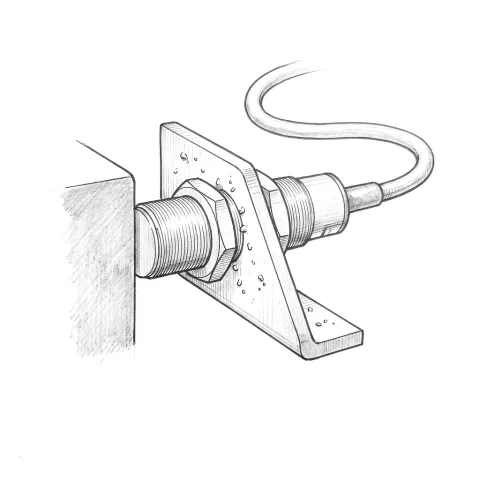
A cheap part, an expensive stoppage
A sensor is one of the cheapest parts in a robot cell, and one of the parts that stops the line most often. A sensor that does not see the part in the fixture will not let the robot start. A sensor that signals when no part is there sends the robot to weld an empty fixture or a part that is not seated. The first costs downtime, the second costs scrap.
The welding cell is the hardest place for a sensor. Welding current creates a strong magnetic field around the cables and the part. In that field, a standard inductive sensor can switch with no target present. Spatter sticks to the sensing face, gradually blinds the sensor or damages its housing. Magnetic cylinder sensors on pneumatic clamps can also be affected by strong fields.
How to choose the right sensor
- Target material: the rated sensing distance of an inductive sensor is given for mild steel. On stainless steel, aluminum and copper it is noticeably shorter. If this is overlooked on a fixture for aluminum parts, the sensor will not see the part. Sensors that detect all metals at the same distance exist for this case.
- Welding environment: in the weld zone, use sensors that the manufacturer specifies as weld-field immune, and housings with coatings that spatter does not stick to easily. Mount the sensor as far from the welding current path as possible and give it mechanical protection.
- Mounting: a flush-mountable sensor sits level with the surrounding metal and is protected from impact. A non-flush sensor detects from further away but needs clear space in front of and around it.
- Environment: temperature, coolant, washdown and pressure decide the housing material and the protection rating (IP67, IP68 and so on).
- Connection: a sensor with an M8 or M12 connector can be swapped in minutes after a failure. With a fixed cable, the cable has to be pulled back to the panel. Splitter boxes connect many sensors on a fixture to the panel through a single cable, which also makes fixture changes easier.
What Senstronic makes
Senstronic is a sensor and connectivity manufacturer founded in 1986, headquartered in Monswiller in Alsace, France. Its range covers:
- Inductive, magnetic and capacitive proximity sensors
- Photoelectric sensors
- Pressure switches
- Pre-wired and field-wireable connectors, adapters
- Passive and logic splitting systems
Its inductive sensors come in cylindrical and rectangular housings, in materials such as stainless steel, PTFE, nickel-plated brass and ceramic. Senstronic serves the automotive, railway, handling, aeronautics and agricultural machinery sectors. In automotive, its products are used in sheet metal work, car body production, presses and assembly lines.
Where sensors matter in our work
- Fixtures: part present, part correctly seated and clamp closed. See fixtures.
- Welding cells: fixture sensors, station and positioner position checks. The full cell is on the robotic welding cell page.
- Conveyors and handling: part counting, positioning, jam and orientation checks. Line-level work is covered under machine and line automation.
Questions buyers ask
Can a Senstronic sensor replace another brand's sensor? In most cases, yes, if the housing size (M12, M18 and so on), output type (PNP or NPN, normally open or normally closed), sensing distance and connector type match. The mounting and the PLC program may not need to change. The sensing distance should still be checked on the real part.
Why do the sensors in my welding cell keep failing? Usually for one of four reasons: spatter, the magnetic field from the welding current, mechanical impact or a damaged cable. Replacing a failed sensor with the same type without knowing which one it is only postpones the problem. Sensor type, mounting position and protection need to be looked at together.