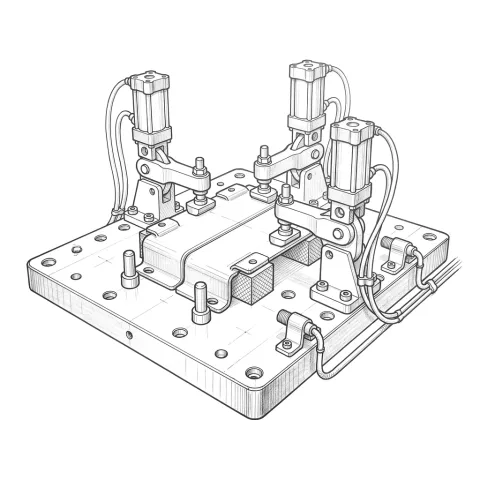
Why the fixture is the quality in robotic welding
The robot does not see the part. It welds where the program assumes the seam is, and the program is taught against the part's position in the fixture. If the part seats one millimeter differently, the weld moves one millimeter too.
A manual welder sees that difference and adjusts; a robot does not. Seam tracking catches the small deviation left from part to part, but it cannot rescue a part that seats differently every time or moves during welding. That is why, in a robotic welding cell, the fixture decides quality first.
How a good fixture works
- Locating (the 3-2-1 principle): a part can slide along three axes and rotate around three: six degrees of freedom. Three support points on the primary surface, two on the secondary and one on the tertiary define all six. The part rests against the same six points every time. Flexible thin sheet parts get more than three supports on the primary surface.
- Pins and datum surfaces: parts are often located from two holes, one with a round pin and the other with a relieved (diamond) pin that leaves play in one direction. That way the tolerance on the hole spacing does not jam the part. The datums are chosen to match the datums on the part drawing, so the fixture and the quality department measure from the same references.
- Clamping: a clamp presses the part onto its locators; it must not bend the part or push it out of position. Low volumes use manual toggle clamps. Series production uses pneumatic clamps that the PLC closes in a set order. The clamp that pushes the part against its datum closes first.
- Part present and clamped: inductive sensors confirm that the part is in place, and cylinder sensors confirm that the clamps have closed. The PLC does not start the robot until it sees all of them. A missing or reversed part is caught before welding, not after.
Four things that make a welding fixture different
- Heat. Welding pulls the part. Clamps go where they limit distortion without locking the part into the fixture after welding. Fixture and weld sequence are designed together.
- Spatter. Supports and pins close to the seam use copper alloy parts that spatter does not stick to easily. Sensors, cables and moving parts are shielded. Sensor selection is covered on the Senstronic sensors page.
- Torch access. Clamps and pins must not stop the robot from bringing the torch to the seam at the right angle. In a new cell, we check this in simulation before anything is built.
- The welding current return path. Welding current flows from the part through the fixture to the ground connection. If that path is not designed, the current tries to pass through pins, bearings or sensor housings; the arc becomes unstable and parts wear early.
Wear parts and part variants
Pins, locating pads and copper supports wear. We design them as removable, numbered spare parts. In a well-designed fixture, replacing a worn pin does not move the datum, so the robot program does not need to be re-taught.
If one cell welds several parts, fixtures are swapped on quick-change plates that seat on reference pins in the same position every time. Coding on the fixture, such as a sensor combination, tells the PLC which fixture is mounted, and the PLC selects the matching robot program. That prevents welding a part with the wrong program.
The same principles apply to assembly and inspection fixtures. Inspection fixtures have one extra rule: clamping must not deform the part, or you end up measuring the clamping force instead of the part.
Design and manufacturing in one team
We design fixtures and do the machining and fabrication in our own workshop. When a new part revision arrives or a pin wears faster than expected, the team that draws the change is also responsible for making the part. That helps a small change move quickly; the real time depends on the scope of the work.
We state in writing in the quote which documents you receive at delivery and how the fixture will be measured.
Questions buyers ask
Can't seam tracking replace a good fixture? Seam tracking can only correct deviation within a certain range. If the part moves in the fixture during welding, no sensor can make up for it. Fixture first, then tracking.
What drives the price of a fixture? Part size and complexity, the number of locating and clamping points, manual or pneumatic clamping, the number of sensors, whether variants need quick change, and the required tolerance.
How long does a fixture last? The base lasts for many years. Pins, pads and copper parts wear with production volume. The maintenance plan should state which part is checked after how many cycles.