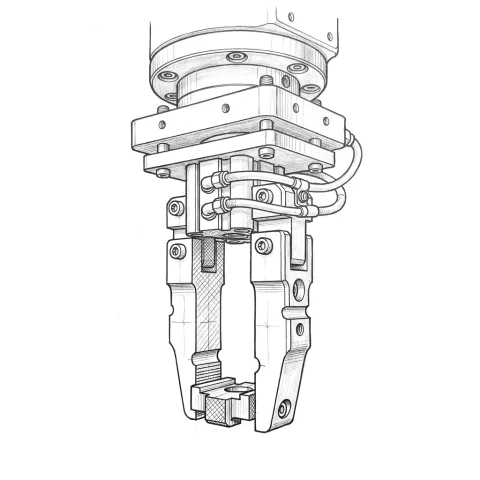
Most cells get stuck at the gripper
When a robot cell is being commissioned, the gripper is often where the most time is lost. The part slips during fast moves, the vacuum holds one carton and not the next, the fingers mark the part surface. Then someone realizes the gripper has to change whenever the product does.
If the gripper is designed too heavy, the problem runs deeper. The robot gets close to its payload limit, can't be run faster, and the gearboxes wear out sooner than expected. The robot itself may be the right choice, and the cell still misses its target time.
Gripper types
- Vacuum gripper: suction cups or foam vacuum pads hold flat, closed surfaces. Suits cartons, sheet metal, glass and plastic panels. On porous surfaces, such as some corrugated board, vacuum leakage has to be allowed for.
- Mechanical finger gripper: pneumatic or electric parallel or angular jaws. The fingertips are machined to the part shape. The most common type in machine tending and assembly.
- Magnetic gripper: holds steel sheet and parts. Permanent-magnet and electro-permanent types can be chosen so they keep holding when air or power is lost. With thin sheet, watch for more than one sheet lifting at once.
- Combined gripper: more than one method on the same body. In palletizing, for example, forks that carry a sack plus suction cups that pick the slip sheet.
- Double gripper: two grippers on one body. In machine tending, the robot enters the machine once, takes the finished part and loads the raw one.
Cells with many part variants use an automatic tool changer. The robot leaves one gripper at a station and picks up another; air, power and signals pass through the changer.
What we look at in the design
- Payload and inertia: the robot's payload includes the gripper, not only the part. The further the load's center of gravity sits from the robot flange, the higher the moment on the wrist axes. We check it against the robot maker's load diagram.
- Part variants: can one gripper hold several parts with adjustable fingers, or is a tool changer needed?
- Cycle time: gripper open and close times, and how hard the robot can accelerate while still holding the part securely, go straight into the cycle time.
- Part-presence sensing: an inductive sensor, a vacuum switch or a jaw position sensor confirms that the robot really has the part. If the part is missing or seated wrongly, the robot doesn't carry on.
- Loss of air or power: the part must not fall when air or power is lost. Mechanical grippers use spring-based grip force retention or check valves. On vacuum grippers a check valve holds the vacuum for a while, and heavy loads get a mechanical support as well. Magnetic grippers use permanent magnets. Which one is sufficient is decided by the risk assessment.
- Wear parts: suction cups, fingertips and foam pads wear over time. We choose standard, easy-to-change parts so your maintenance team can keep spares on the shelf.
One limit, honestly: no gripper on its own solves a part that arrives in a different position every time. Part presentation has to be designed together with the gripper, and where needed machine vision finds the part position.
What we do
- Gripper design for your part and your cell
- Payload and inertia checks, and input to robot selection
- Machining of bodies, fingers and adapters in our own workshop
- Pneumatics, sensors and cable and hose routing
- Assembly and commissioning in the cell
- New grippers for new part variants on existing cells, or redesign of an existing gripper
Choosing a gripper for palletizing
In robotic palletizing, the product decides the gripper. Zoned vacuum for cartons, a fork-type bag gripper that carries sacks from below, clamps for crates. If the same gripper also picks slip sheets or empty pallets, suction cups or pallet forks are added to it.
Questions buyers ask
Can we order just a gripper for our existing robot? Yes. We need the robot model, the flange size and your parts. We check that the new gripper stays within the robot's payload limits.
Off-the-shelf or custom gripper? Standard jaws, suction cups or parallel grippers are usually part of the design anyway. What is custom is the fingertips, the body and the layout that fits your part. If an off-the-shelf product does the job, we'll recommend it.
How long does a gripper change take? For grippers changed by hand, we use a quick-change plate. If frequent changes are needed, an automatic tool changer brings the change down to a few seconds.