The hardest station in the plant to staff
At the end of the line, one operator spends the shift lifting 25 kg sacks or full cartons, turning and stacking them on a pallet. It is one of the most common sources of back and shoulder injuries in a plant. Turnover is high, and finding someone for this station on every shift is a problem of its own.
Fatigue shows in the stacking too. Late in the shift, layers shift, pallets topple in transit or the bottom cartons get crushed. However fast the line runs, if the person stacking pallets can't keep up, the end of the line stays the bottleneck.
How a palletizing cell works
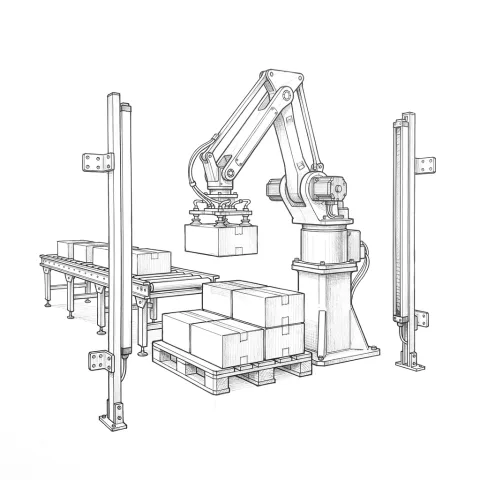
Product arrives on a conveyor, is turned and grouped if needed, and the robot picks it with its gripper and places it on the pallet according to the pattern. The cell is made of these parts:
- Pallet pattern: how products sit within one layer. Layers are usually rotated in turn so they interlock and the load stays together in transport.
- Slip sheets: cardboard or plastic sheets between layers. The robot can pick them from a magazine with suction cups on the same gripper.
- Pallet supply and exchange: empty pallets come from a pallet dispenser. Most cells have two pallet stations, so the robot fills one while the full pallet is taken from the other.
- Hand-off to stretch wrapping: the full pallet moves by conveyor to the stretch wrapper and labeling. We set up the signal exchange with your existing wrapper as part of the cell.
- Product changeover with recipes: each product's size, weight, pattern and layer count are stored in a recipe. When the product changes, the operator selects the recipe on the panel. Nobody touches the robot program.
The product decides the gripper. Cartons and flat-topped packs use a vacuum gripper; zoned vacuum lets it pick one or several cartons at once. Sacks often can't be held reliably by vacuum, so a fork-type bag gripper carries them from below. Crates and packs that can be squeezed from the sides suit a clamp gripper. More on the gripper design page.
One limit, stated up front: a palletizing cell stacks product that arrives in good shape. A crushed carton, a bulging sack or products stuck together on the conveyor cause problems in the cell too. We watch how your product actually arrives during the first visit.
Safety during pallet exchange
The cell is fenced, and the pallet entry and exit openings have light curtains. When a full pallet leaves on the conveyor, the light curtain is briefly bypassed; this is called muting. Muting sensors sit in front of and behind the curtain and bridge it only for a pallet that passes them in the right sequence. A person walking in can't create that sequence, breaks the curtain and the robot stops.
The robot is kept out of a pallet station while a forklift or operator is in it. That boundary is enforced by the safety circuit or by the robot's safety-rated zone monitoring (for example ABB SafeMove or KUKA SafeOperation). Meanwhile, the robot keeps working at the other station. The Performance Level (PL) the safety circuit must reach comes out of the risk assessment.
When does a collaborative palletizer make sense?
If line speed is low and space is tight, a collaborative robot (cobot) is a good option. It fits a smaller footprint and often needs no full fence. It has a price: a cobot runs slower, carries less and often needs a lifting column to reach the top of a tall pallet. Payload is calculated including the gripper's own weight.
A cobot cell is not installed without guarding until the risk assessment says it can be. In most applications an area scanner detects an approaching person and slows or stops the robot. If your product is heavy or your line is fast, an industrial palletizing robot is the right choice. We'll work out which one suits you, with numbers.
How a project runs
- Site visit and data: product sizes and weights, pallet type (for example a 1200 x 800 mm EUR pallet), required patterns, line speed and shift pattern.
- Layout and simulation: we build the cell in simulation and check cycle time against line speed.
- Design and manufacturing: gripper, conveyors, guarding, control panel and PLC program.
- Pre-shipment test: Before shipping, we see the cell run together.
- Installation, commissioning and training: your operators learn recipe selection and pallet exchange, your maintenance team learns fault handling.
Questions buyers ask
How many pallets an hour will it do? It depends on product weight, the pattern, how many products the robot picks at once and the pallet exchange time. We calculate it in simulation for your product and your pattern, not from a rule of thumb.
Can one robot palletize more than one line? Yes, if the combined line speed fits within the robot's cycle time. The robot stacks each line's product on its own pallet. We check this in simulation before anything is installed.
Do we need a programmer to add a new product? It can be set up so you don't. During design we agree which parameters (size, pattern, layer count) are open to the operator.