Most projects slip on site
The cell ran in the workshop. On site, things change. The floor isn't flat, power and compressed air aren't where the drawing shows them, and real parts differ from the trial parts. Installation happens between running lines, in the middle of crane and forklift traffic.
If the site crew is disconnected from the people who designed the cell, every problem becomes a chain of phone calls. Commissioning drags, ramp-up slips, and production goes back to the old method before it has learned to trust the new cell.
What site installation covers
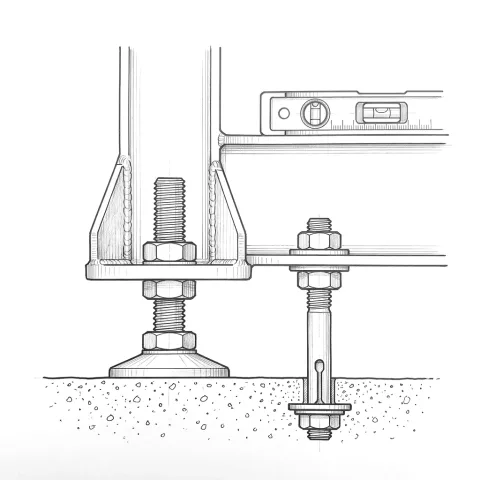
- Mechanical installation: placing, levelling and anchoring robots, positioners, fixtures, guarding and conveyors.
- Electrical installation: control cabinets, cable trays, field wiring, sensors and pneumatics.
- Alignment and calibration: measuring the robot-to-fixture relationship, verifying the TCP, teaching fixture reference frames to the robot and correcting program points for the as-installed situation.
- Tie-in to the existing line: connecting conveyors, signal exchange with the line PLC and integrating the emergency stop circuit.
- Commissioning: individual functions first, then safety tests, then automatic running on real parts.
One honest limit: a good installation won't cover for a weak design. If the cell didn't reach its target cycle time in the workshop, it won't reach it on site. That's why we take the FAT seriously before anything ships.
FAT and SAT: two acceptance tests, two different questions
The FAT (factory acceptance test) runs the cell in the builder's workshop before shipping. Its question: does the cell do the job that was agreed? Motions, safety functions, cycle time and part quality are checked, ideally with the customer present. A fault found in the workshop costs far less to fix than one found on site.
The SAT (site acceptance test) runs the same cell in your plant, on your power supply, with your parts and your operators. Its question is different: does the cell work here, under real conditions? After the SAT comes ramp-up: the cell has to produce at target rate and quality for an agreed period before it counts as fully handed over.
Installing without stopping production
Most of the installation can be done while neighbouring lines keep running. We fence off the work area and plan crane and forklift use with the production team. Noisy or dusty work is scheduled around your shift pattern. The jobs that genuinely need a stop, such as tying into the existing line or cutting power or air, are grouped into short, pre-planned windows.
What you get at handover
At handover we leave you with these documents.
- Up-to-date mechanical drawings and electrical schematics
- Backups of robot programs, robot configuration and the PLC and HMI projects
- Operating and maintenance instructions, spare parts list
- Acceptance test records
Training is part of handover. Operators learn daily operation, part changeover and basic fault finding. Your maintenance team learns how to back up programs, check calibration and work through the periodic maintenance points.
A site crew for your project
We also install and commission on other integrators' and machine builders' projects, to their drawings and their schedule. In practice that means a crew working in your name, in front of your customer. Before we start, we agree in writing who is responsible for what, how we report, who talks to the end customer and which site rules apply: permits to work, lockout/tagout, the plant's safety induction. If you are running a project in Europe, you will want four answers before booking a crew: lead time, crew size, reporting language and qualifications. We give all four in writing with the quote.
Questions buyers ask
We bought the cell from someone else. Can you install it? Yes, provided we have the drawings and programs. If something goes wrong during commissioning, we help you separate a design problem from an installation problem.
How soon can a crew be on site? It depends on the scope of the job and where the site is; we give you the lead time in writing in the quote.