The line runs, but nobody knows where the time goes
Many lines grow one machine at a time over the years. Each machine has its own controller, its own panel and sometimes its own builder. Between them, an operator carries the part, presses the button and writes the count on a form at the end of the shift.
When the line stops, the reason is usually logged as "breakdown", or not logged at all. Maintenance can't see which alarm comes back every week. Production can't tell whether lost output comes from a slow station, waiting for material or product changeovers. And a small change to the sequence means waiting for the one person who knows the program.
What layers make up an automation system?
- Field level: sensors, valves, motors and drives. They measure the machine's state and make the movement.
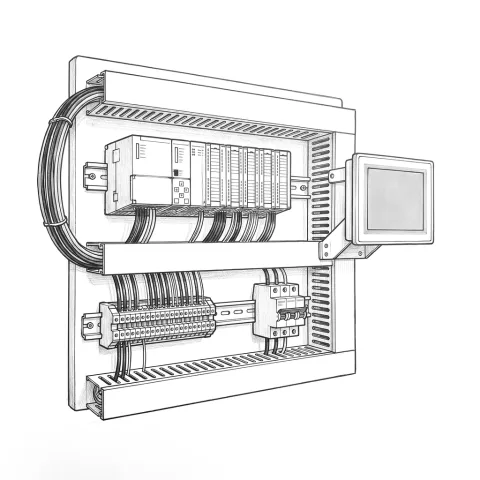
- PLC: the controller that runs the machine's sequence. It reads sensors, decides and drives valves and motors.
- HMI: the touch panel where the operator runs the machine, selects recipes and sees alarms.
- SCADA: the supervisory layer that shows the whole line on one screen and logs data.
The safety circuit is designed separately: emergency stops, door interlocks, light curtains and the safety PLC or safety relay that evaluates them. The required level comes out of the risk assessment and is expressed as a Performance Level (PL) under ISO 13849, for example PL d. A significant change to a machine already in service can mean the risk assessment has to be redone.
What does "IIoT" or line data really mean?
IIoT is often presented as a large digital transformation program. On the shop floor it is much simpler: the machine records what it is doing.
- Part counts: per shift, product and machine, without paper forms
- Downtime reasons: the machine signal logs how long it stopped; the operator picks the reason on the panel: waiting for material, setup, breakdown, quality
- Cycle times: which station is holding the line back
- Energy: consumption per machine or line, and how long machines run idle
- Alarms: which alarm repeats, how often and on which shift
From this data you get OEE (overall equipment effectiveness). Maintenance sees the recurring fault and production sees the lost time, on the same screen.
One limit worth saying: data on its own fixes nothing. Someone has to look at it every week and act on it. That is why we suggest starting with the bottleneck machine and a few meaningful indicators, not the whole line at once.
What we do
We have completed many projects in control systems integration and quality control automation. On a project, our scope covers:
- Control architecture and functional specification
- Electrical design, panel design and build
- PLC and HMI programming
- Drives and motion: frequency inverters and servo axes
- Safety circuit: risk assessment, PL calculation, safety PLC or relay
- SCADA and line data: counts, downtime reasons, cycle times, energy and alarm logs
- Inspection stations with machine vision
- On-site commissioning, operator and maintenance training, documentation
How a project runs
- Site visit: we see the machine and line in place and agree the goal: which steps become automatic, which data is needed.
- Functional specification: together we write down and sign off what the machine does, in what sequence, and what happens at each fault. Agreeing on this text before programming means fewer changes on site.
- Design: electrical drawings, panel layout, network and safety circuit.
- Panel build and programming
- Testing: we test the panel signal by signal before it ships and run the program in simulation. On projects that include a robot cell, virtual commissioning runs the PLC program against the simulated cell.
- On-site commissioning: on a running line, we schedule installation for the times that disturb production least.
- Training and handover: operator and maintenance training, electrical drawings, program backup.
Questions buyers ask
Can you connect our existing machines? Usually, yes. Most current PLCs can share data through standard interfaces such as OPC UA. On older machines with no communication port, we pick up the signals with extra sensors or a small I/O module. If the machine's PLC is itself end-of-life, a PLC migration comes first.
Can it be done without stopping production? Most of the panel build, programming and testing is finished before any shutdown. Connection and commissioning need a short stop, which we plan around a weekend or a scheduled maintenance shutdown.
Will the program be locked, or can our maintenance team make changes? At handover you receive the commented source program, a backup and up-to-date electrical drawings. We train your maintenance team for troubleshooting and simple changes. After commissioning, our PLC and SCADA support is available 24/7.